
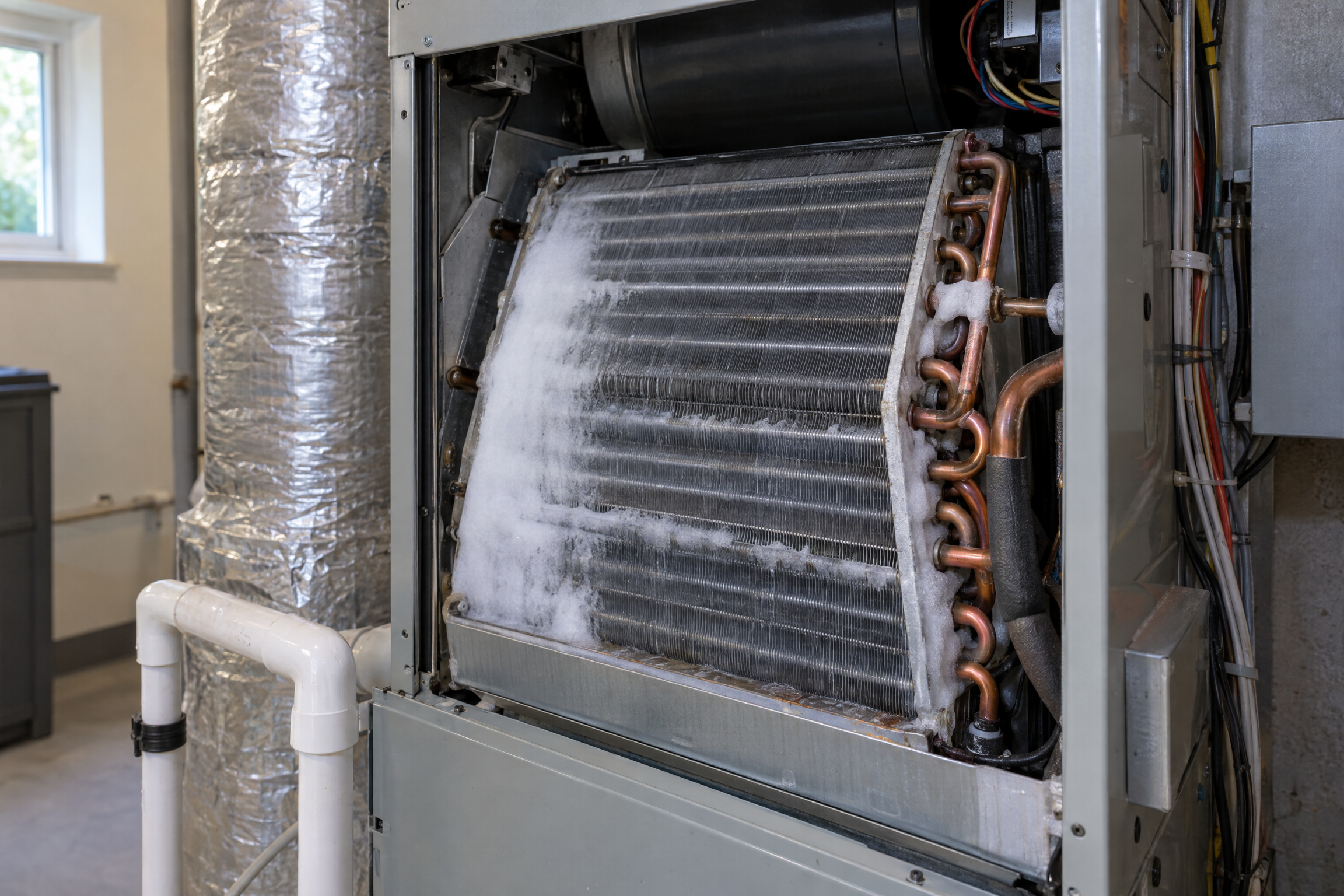
 Illustrative editorial imagery · Not an Able Air job-site photograph
THE COMFORT TAKEAWAY
If you see ice, turn cooling off and let the system thaw naturally. Check only the accessible filter and clear vents; if ice returns, airflow stays weak, or water reaches electrical equipment, keep it off and arrange qualified service.
The short answer
If you see ice on your indoor air-conditioning coil or the insulated refrigerant line, switch the thermostat from Cool to Off. Do not keep running cooling. Let the ice melt naturally, check only the accessible filter and clear vents, and arrange professional service if the ice returns or airflow remains weak.
A frozen coil is a symptom, not a diagnosis. Restricted airflow is one common cause, but a blower problem, a dirty coil, or a refrigerant issue may also be involved. Carrier advises turning a frozen system off and addressing its underlying cause rather than letting it continue to run. Carrier’s frozen-coil guidance.
Safe checks to make first
Turn off cooling. Use the thermostat to stop the cooling cycle. If you notice water near electrical parts, a burning smell, repeated breaker trips, or unusual electrical noises, leave the system off and do not touch the equipment.
Check the filter only if it is readily accessible. With cooling off, look for a heavily loaded or blocked filter. Replace it only with the size and type specified for your equipment. ENERGY STAR recommends checking central-system filters monthly and replacing or cleaning them as appropriate; follow your system’s instructions. ENERGY STAR maintenance checklist.
Look for blocked air paths. Make sure supply registers and return grilles are open and not covered by rugs, furniture, or stored items. Do not remove equipment panels, reach into the blower or coil, straighten coil fins, or handle wiring.
Protect the area as the ice melts. Put towels or a shallow container where it is safe to catch drips, and move belongings away from the air handler. Keep water away from electrical equipment. If water is spreading or near wiring, leave the system off and call for service.
Why an AC coil freezes
An evaporator coil can ice when heat and airflow across it are not as intended. A dirty filter, blocked return, closed registers, or a blower or coil problem can restrict airflow. Refrigerant or control problems are other possibilities. Seeing ice cannot tell you which cause applies, so do not assume the system simply needs more refrigerant.
The U.S. Department of Energy explains that central AC depends on correctly operating indoor and outdoor components, unobstructed airflow, and the proper refrigerant charge. Its maintenance guidance recommends checking airflow and equipment condition as part of professional service. U.S. Department of Energy: Central Air Conditioning.
A refrigerant problem needs qualified diagnosis. EPA rules require technicians who service equipment that could release regulated refrigerants to hold the applicable Section 608 certification. U.S. EPA Section 608 certification.
How to let the system thaw
Leave cooling off until all visible ice has melted. Thawing can take several hours and depends on how much ice has formed and where it is; do not rely on a fixed timer. Never chip, scrape, or pry ice from the coil or tubing. Do not use a hair dryer, space heater, heat gun, or hot water to speed it up; sudden or uneven heat can damage components.
If the equipment manual permits and there is no water or electrical concern, the thermostat’s Fan Only setting may help move room-temperature air across the coil. Do not use Fan Only if it worsens a leak or conflicts with the manufacturer’s instructions. Carrier describes this as an optional thawing aid, while warning homeowners not to apply external heat. See Carrier’s full steps.
Once thawed, a clean specified filter and clear grilles may address a simple airflow restriction. If ice forms again after cooling resumes, switch cooling off and call a technician instead of repeatedly restarting the system.
When to call an HVAC professional
Arrange service if the coil freezes again, airflow is still weak after the filter and registers are checked, the indoor blower does not seem to run, or you cannot safely reach the filter. A technician can check the blower, coil, controls, drain, airflow, and refrigerant conditions to find the cause.
Call promptly if thawing water is damaging a ceiling, wall, floor, or nearby belongings. If you smell something burning, hear unusual electrical sounds, or a breaker trips, leave the system off and do not keep resetting it. Avoid touching water near wiring or opening access panels.
Do not try to add refrigerant yourself. EPA warns that propane and other unapproved flammable refrigerants are a fire or explosion hazard in home air-conditioning systems not designed for them. U.S. EPA homeowner guidance on AC repair and refrigerants.
The Long Island next step
Before you call, note where you saw ice, whether the filter was blocked, how strong the airflow felt, whether water appeared as the system thawed, and whether the problem returned after restarting. Photos taken from a safe distance can also help explain what you noticed.
Able Air Conditioning & Heating Corp. provides cooling service across Nassau and Suffolk County. Learn about air-conditioning service, central AC, HVAC service and repair, and Long Island service areas. For help, contact Able Air or call (516) 764-4300. You can also browse the Able Air Journal and heating services.
A few more good questions.
Should I turn off my AC if the coil is frozen?
Yes. Set the thermostat to Off so the cooling cycle stops. Let the ice melt naturally and leave the system off if water, electrical symptoms, or recurring ice is present.
Can I run the fan to thaw a frozen AC coil?
Only if your equipment instructions permit it and there is no water or electrical concern. Fan Only may help circulate room-temperature air, but do not run cooling or use an external heat source.
Can a dirty air filter make an AC freeze?
A heavily blocked filter can restrict airflow and contribute to icing. Check an accessible filter with cooling off and replace it with the specified type, but call for service if ice returns or airflow stays weak.
Can I add refrigerant to stop my AC from freezing?
No. Ice does not prove that refrigerant is low, and refrigerant service needs qualified diagnosis. A low charge can point to a leak; do not use DIY recharge products.
How long does a frozen AC coil take to thaw?
It varies with the amount of ice and the system. Wait until all visible ice is gone, keep cooling off, and do not chip the ice or use a heater to speed thawing.
Keep learning
Authoritative sources behind this guide.